Great Video About the School!

October 21st, 2009 by Dan

Loretta, one of our volunteers from this past summer, has created a great video about Ghanain culture and our school, the AYI Owen International School.  To help us further our efforts and hopefully create other schools, please donate now.

What does it take to give a scholarship to a needy child in Ghana?

February 27th, 2010 by james

Scholarships for needy children involve more than you might expect. Here are the key items/costs associated with giving a child a scholarship. Total cost for one child still amounts to less than a dollar a day.

  1. Healthcare – Children can have easily curable diseases that need to be addressed for the child to be able to focus on learning
  2. Clothing and shoes – In a cash society, one of the criteria of a “needy child” is one without shoes and tattered clothing.
  3. Books, notebooks, pencils, etc. – When parents can’t afford flip flops, books don’t make the priority list, so that needs to be provided.
  4. School fees

Volunteer Spotlight: Bouyem Bat Caves

February 19th, 2010 by Dan

We were fortunate to be able to join any school field trips during our stay.  One trip was an excursion with the Primary 4 class.  With the 26 students we piled onto the old school bus and headed off to the Buoyem Bat Caves.

Although the town of Bouyem was only located 8km away, the road there was quite bad.  There were large ruts in the road cut out by the heavy rains and the bus struggled through it.  Luckily we were warned that we would need long pants, shoes, and hats for the day because the trails and caves would be muddy.  We had to pick up a guide first from the town before traveling to the trail head.

PICTURES 2417

The cave went in fairly deep, required getting low again but then opened up to reveal caverns with a ceiling high enough to stand in.  We could hear the bats in the cave before we entered.  The guide explained that these were smaller bats, but there were thousands of them inhabiting the caves.  We could not see the bats at first, only hear them whizzing by our heads.  In this cave, there were two openings in the ceilings that let natural light inside.  The cave was said to be inhabited by the local tribes people seeking refuge during a war many years ago.  This was seen by the evidence of cave drawings and worn rock carvings present on the cave floors and walls.

PICTURES 2363

On our way to the third and final cave, we stopped upon a rock face that had an amazing panoramic view of the lush countryside.  The children had a blast playing on the rocks and it was difficult to get them to leave.  We finally arrived at the last cave which the guide described as containing much larger bats. He also mentioned that we would not be leaving through the same way we entered.  This cave was the most impressive and also had the most history to it.  It was discovered by hunters for the Ashanti tribe.  They caught a bat, cooked it, fed it to a dog, and when they realized the dog did not die, they knew they could eat the bats.  They held the bats as sacred and bat meat became a large part of their diet.  Eventually a war broke out, and the chiefs had to hide in the caves for shelter.  Some people died in the caves, and so out of respect, our guide did a ceremonial libation to the chiefs before we entered.  He took some schnapps, spit it into the air then said a prayer and poured it on the ground.  He offered for us to drink some, but because we wanted to hike out alive we kindly refused.  The libation was to ensure nothing bad would happen to us in the cave.

PICTURES 2390

This cave again required us to crawl on our hands and knees, but this time through a narrow passage.  Bats were flying everywhere as we tried to maneuver through a small tunnel.  It was quite the experience.  The tunnel finally opened up to a large room with a ladder to climb out.  We climbed the ladder and then had to scurry up vines to fully get out of the caves.

The guide caught one of the larger bats and brought it outside for us to hold.  Its wingspan was about a foot and a half in length and it was one of the weirder things I have ever held.  Its bones were so thin and light I thought it might break when it flapped its wings in my grasp.  Its wings were made out of a flexible and stretchy, leathery skin.  The bat tried biting me when I held it, so I held it just long enough for a picture before handing it to an eagerly awaiting student.

PICTURES 2408

The tour was finally over and we headed back to where our bus had last left us. We had come full circle and the trip had taken a little more than two hours, not bad with all the kids.

For One World Annual Appeal and 2009 Thank You!

December 30th, 2009 by james

Dear supporters of For One World,

Thank you to all who have made a generous financial donation to For One World in 2009! If you are considering a donation, this is a great organization with a track record of success and zero overhead. Even a small donation goes a long way in Ghana.

Donate.ForOneWorld.org

In 2009 we helped support 14 orphans living at the school providing food, shelter, schooling, clothing, love and a great basic education. We supported dozens of children via scholarships, mostly for girls and the poorest in the community by helping to provide basic education, shoes, clothing and medical care.  Alex Van Voorhees coordinated four outstanding volunteers who donated their own time and money to help with skills not locally available: Loretta Cremmins, Max Alderman, Caitlin Mackeown, and Betty Cremmins. These volunteers helped Ayi Owen International School once again attain a rank academically in the top 10% of all schools in the district. Zachary Cutler and Lizzy Edelstein coordinated the most successful gift drive to date thanks to in part by the generosity from the Bridget Kelly Peterson family and Erica Myrickes. It is an honor to be collaborating with so many talented volunteers like John Donelly, Michele Palma and Dan Ochs who have spent countless hours of service
managing our 501c3 nonprofit accounting, acknowledgements and website respectively.

We continue to make improvements to the buildings at the new school site and have expanded to almost 400 students. This is possible through the financial generosity of the Bill Owen family, Anne Ochs family, James Alderman family, Gretchen Peterson and Leverett Smith as well as many others. We can be most thankful in 2009 for founder Ayisatu’s successful operation and return to health.  Thank you!

Looking forward to a great 2010!
James

Volunteer Spotlight: Kindergarten Graduation

December 23rd, 2009 by Dan

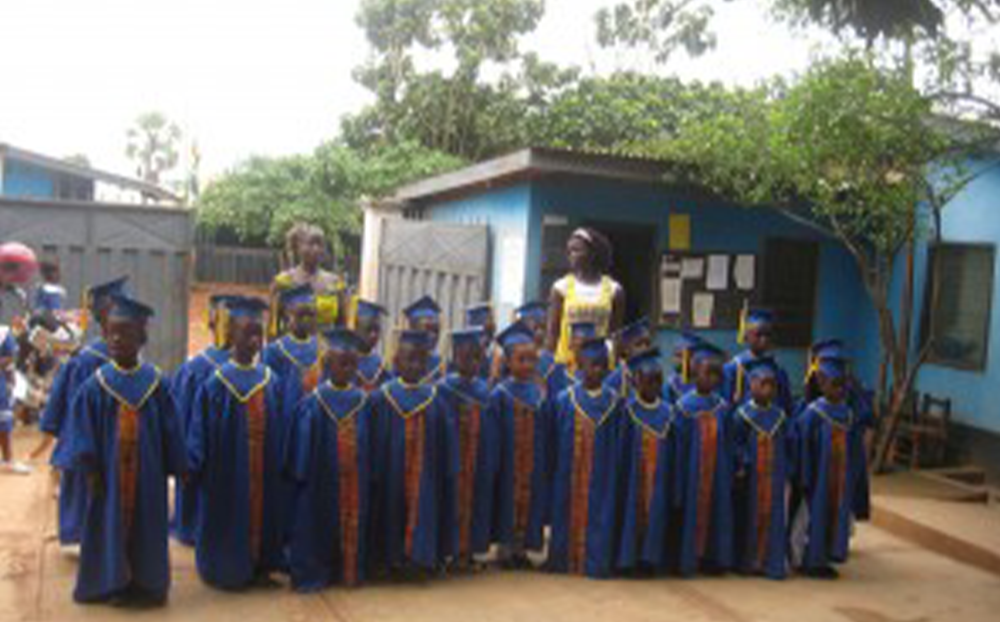
Today was the day of the esteemed and much awaited day of Kindergarten graduation.  For some reason, it is a very big deal in Ghana.  An elegant set up was created for the event complete with large speakers, chairs and tables.  The event was supposed to start at 10 am, but like always it did not begin until noon.  The entire lower school was in attendance as well as all the teachers.  Many members from the Parent Teachers Association as well as the Ghana Board of Education were present for the ceremony. To our surprise, nearly every parent of the children was sure to make an appearance.  The music, as always, was being played at a ridiculously high volume, and it was the same songs over and over again.

Kindergarten Graduation 1

The ceremony began with a prayer and then introductions.  The event was run by the master of ceremonies and one of the school’s teachers, Somaila.  He does a great job controlling the order of the program and interacting with the audience.  The ceremony contained many traditions, the first of which involved the kindergarten class standing coming on stage and performing a song for the audience.  The students then proceeded to change into athletic clothes to play games.  Everyone transitioned over to the fields to watch the children compete in tug of war, sack races, and spoon balancing races.  It was adorable to watch and the parents enjoyed the fun competition.

Kindergarten Graduation - Sac RaceKindergarten Graduation - Tug Rope

After the field games had finished, the students changed into their cultural uniforms.  They performed a play and then a cultural dance they had been working hard on all semester.  Still in their same uniforms, each child stepped up to the podium and recited a poem of their choice.  This took some time as you can imagine, but it was a pleasure to hear the students that were strong public speakers.  For students that performed particularly well, parents and others from the audience would throw money at them to donate towards the school.  One boy cried every time he had to speak publicly, this brought much laughter from the student body and I felt so bad for him.

The class then went into the library to change into their blue graduating gowns complete with caps and kente cloth lining.  During this time, the lower school held a dance competition to pass the time.  Finally the kindergarten class returned in their robes and strolled two by two onto the center stage to receive their official diplomas.  After each student received his/her certificate their picture was taken with their respective parents who were in attendance, which was mostly mothers.  Every mother in the audience seemed to be carrying a baby which I also found interesting.

Kindergarten Graduation 2

The ceremony crawled on in typical Ghanaian fashion with more announcements and presentations. I was amazed at the patience exercised by the rest of the lower class school-mates that continued watching attentively.  Many pictures were taken throughout the ceremony by a hired photographer and I was flabbergast to see some parents in the audience already holding printed pictures of their child!  I discovered later that the dj’s had brought a printer on site which the man was using to print pictures straight from his digital camera.  It was actually a great idea and the man was surely turning a nice profit.

After many grueling hours the ceremony finally came to a close. Mmaa and Bill both looked very pleased with the way things went and it was great to witness such a meaningful milestone event in the children’s lives.  It was especially nice to see Mohammed, one of the children from the house, graduate with his classmates.

Kindergarten Graduation

Volunteer Spotlight: Market

December 2nd, 2009 by Dan

We had the opportunity to travel to market with Miriam, one of the older girls from the house who is in the P6 class.   We left the house at around 9:30 am and walked to the top of the hill through the Takofiano neighborhood to catch a taxi.  With us we brought a basket to keep the goods.  It was necessary for us to have Miriam as a guide through the labyrinth of the market and also as a translator to help us barter for lower prices.

The taxi dropped us off in the middle of the market.  The market was everything we had heard and more.  It was full of people and booths containing every item imaginable.  We had a list of items we wanted to buy including onions, green peppers, carrots, beans, rice, eggs, oil, and oatmeal.  The vegetables were much cheaper than we expected.  All of the vegetables came to be around 5 dollars US.  We purchased 15 eggs for around two dollars.

atTheMarket1 atTheMarket2

I also wanted to purchase a traditional African tunic.  A man was trying to help me buy one and I had to try to tell him that I did not want one of the many used westernized shirts that have been imported from America.  I finally found a blue, white, and black striped, hand woven tunic which they referred to as a fugu or smok, that I liked and fit me well.  It came to 30 cedi which was much more expensive than I had planned, but I really needed another shirt to wear.

We were fortunate to have Miriam with us to negotiate prices to ensure we were not getting ripped off.  We walked all across the market multiple times picking items up from the best places.  There seemed to be no rhyme or reason to it and we consequently covered a lot of ground.  We spent a full hour and a half at the market in total.  It was an exhausting experience.  Taxis and cargo trucks constantly honk their horns to tell people to move out of the way on small busy streets.  This is better still then men with overfilled wheelbarrows and women carrying large loads on their heads that plow through the streets without giving you warning.

atTheMarket3 atTheMarket4

Loretta and I are also more of a spectacle walking through the market.  Many people shout at us and run up to touch us.  We get many marriage proposals from random strangers that want us to take them to America.

atTheMarket5

Volunteer Spotlight: Class Trip to Cassava Factory

November 21st, 2009 by Dan

On our way back from the Bat Caves the class stopped at a town that specialized in the production of Gari, a food made from the processing of cassava root.  We arrived at the factory at around 3:30, the sun was still hot but it made for lighting that was quite dramatic.  The entire village was based around this factory, which did not look like your typical factory encapsulated in one building, but rather spread out throughout a section of the town.

Cassava Factory

We first saw a woman cutting the cassava root by removing the outside and revealing the white starchy inside.  Next, the starchy remains are fed through a pulverizer attached to a conveyer belt.  This crushed the root into a finer white powder.  The people who ran these machines would get covered in the white powder and it was a heat producing process contained in a small room. Inhaling the particles seemed inevitable.  The powder was then taken outside, water is added to it and it is packed into large bags to ferment.  The bags are then placed in a oversized vice where the water is pressed out of the cassava and it is left to dry in the sun.  This did not smell so good.

Cassava Factory - Raw Material Cassava Factory - Crushing Process Cassava Factory - Drying Process

After this process the product is sent to another woman who places the cassava on a large metal stove with fire underneath.  The woman moves the powder around with metal ladles to ensure the product is evenly toasted.  This section smelled like smartfood popcorn for some reason.

Cassava Factory - Mixing ProcessCassava Factory - Waste Pile

The mother of one of the students actually worked at the plant and so she stood as the children asked her many questions they had formulated during the tour.  The children did this for a solid half hour and were very interested in the production method.  Meanwhile our group had attracted a good deal of attention from the local townspeople.  Children huddled around our group and would stare at us.  It was quite the interesting experience.  The final product made was called Gari.  It is a traditional food of Ghana that they use to add to dishes to enhance flavor and increase thickness.

Student Profile – Naha

October 21st, 2009 by Dan

The following is a description by one of our volunteers of one of the students living at the school and being taken care of by your donations.

Naha

Age: 10
Class: P2-A

Interests:

  • Favorite Subject: Science
  • Favorite Activity: Playing football (soccer)
  • Favorite Sport: Basketball
  • Favorite Color: Yellow
  • Favorite Food: Rice ball and ground nut soup
  • Favorite Singer: Shaggy
  • Favorite Person: Mr. Sumaila (one of the school teachers)
  • Favorite Book: Rainbow Fish
  • Favorite Movie: Finding Nemo
  • Favorite Animal: Horse
  • What she wants to be when she is older: Doctor

Parents: Naha’s father, Awudu, is one of Mmaa’s brothers.  Naha’s mother is one of three wives.

Town of birth: Unknown

Naha1

Background: Naha comes from a poor family that never invested any money in its females. Naha’s father is a farmer with three wives and eighteen children.  The father believed that only his sons should go to school, therefore none of his daughters ever received the opportunity to be educated.  When the father was young, he thought he could take care of all the children, but he soon became overwhelmed.  He became sick with older age and was unable to work and provide for his family.  He could no longer pay the school fees for any of his children, let alone clothes to dress them.

Mmaa remembers that Naha’s father came to her one day when his wife was pregnant with another child.  He told Mmaa that if the child was a girl it would be hers and if it was a boy he would keep it.  Mmaa was not sure how to respond to the situation, but out of guilt she agreed to purchase the pregnant mother a cloth to wrap the baby in when it was born.

After some time Mmaa had completely forgotten about the situation.  Then one day, the mother showed up at Mmaa’s door holding baby Naha in her arms.  She told Mmaa that her father ordered her to give the baby up and thus Mmaa had no choice but to accept her.  Mmaa allowed little Naha to eat and sleep at her house and agreed to send her to school to give her an opportunity she herself never had.

Naha helping to cook

Bill explained that Naha was a consequence of poverty in Ghana.  When she arrived at the house she was emaciated, poorly clothed, never spoke and avoided most interactions with others.  Mmaa first placed Naha into kindergarten at a government school, but it did not work well for her.  Mmaa then decided to move Naha to a different local private school called Animantu, but again Naha was not performing well and was years behind in both reading and writing.  Bill described Naha as being verbally inarticulate and difficult to motivate.  Mmaa finally brought Naha to the Ayi Owen School and placed her in first grade.  Although she was old for the grade, she began to perform well and has been doing so ever since.

Bill fondly recalls that when Naha was still in preschool, maybe three or four years of age, she would sneak off with Bill to play basketball after finishing her homework.  After some time, Bill would leave the ball out for her to use when he was not around.  Bill observed how Naha would throw the basketball underhand towards the rim over and over again. Bill noted that Naha was determined to make a basket, and from that he knew she had a special drive in her.  It became clear to the Owens that Naha expressed herself more through sports than words.

Mmaa explained that Naha’s mother and father have each come only once to visit Naha at the house.  When the father asked “Do you know who I am?” to Naha, she responded that she knew who he was, but refused to refer to him as her father.  Some of Naha’s brothers and sisters have stopped by to visit, but Naha does not care for them as they were not there for her when she needed support.  Mmaa continues to be the sole supporter and provider of Naha because her parents are incapable and imprudent.

Naha carrying grains

Naha’s real name is Alimatu, after Mmaa’s mother.  But to avoid confusion she has always been referred to as Naha, which actually means ‘grandmother’.  Naha has a tribal marking on her face that she received when she was an infant.  The horizontal scar is a symbol of the Bole tribe.  When the cut is first made, it is filled with medicine in order to act as protection from diseases throughout the individual’s life.  It is also a sign that Naha will always be part of the Bole tribe and to remind her of her roots.

Naha has progressed tremendously under the care of Bill and Ayisatu. She has doubled in size since she first came to them more than eight years ago.   She now excels in school by being in the top quarter of her class and gets along well with the other children at the house.  Naha helps out around the house by cooking, cleaning, washing clothes and performing any minor duty that needs to be done.  In her free time she loves to jump rope, dance, draw, and play games.  Naha always has a smile on her face and is very fun-loving and approachable.  With the continued support of the Owen family and her peers at the school, there is no doubt that she will continue to thrive in such a nurturing environment.

If you would like to help Naha and other children living at the school, please donateContact us if you would like to sponsor her or other students living at the school.

Obama in Ghana

July 13th, 2009 by Dan

With President Obama in Ghana, there are lots of articles going up on the web.  One good one is by BONO for the New York Times and can be seen here.

ATTENTION FOW TEAM!! UPDATED WISH LIST

May 11th, 2009 by Zachary Cutler

ATTN: For One World Team
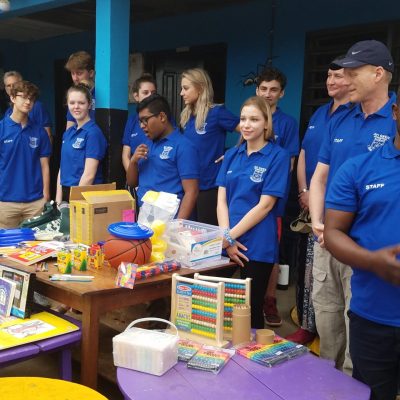
Please find below the most recent “Wish List” of items for the Ayi Owen School.  We have a short deadline for these items to be collected.
* Donations Must Arrive by May 21
* Where to send donations:

FBO Loretta Cremmins,  ATTN: Lizzy Edelstein
504 West 110th Street Apt 2A NY, NY 10025)

2009.05.11 PRIMARY WISH LIST:
1.    Max to pick up at Janie Owens: Tennis balls.
2.    A Stopwatch
3.    Playing Cards (for math games) (Plastic coated or laminated)
4.    Candy-land game
5.    Balls: Basketball, Volleyball
6.    Laser pointers (for sample of teachers)
7.    Large diameter pencils for Kg pupils
8.    Art materials. eg pad of multi-color paper
9.    Colored pencils
10.    Finger paints
11.    Basic bic pens
12.    Pens with different color inks… different color exterior.
13.    Monster mask (not too scary) and or wigs are useful for the drama group
14.    Blue T-shirts for all 27 teachers. A FEW MEDIUM BUT MOST XL.
15.    Middle school math sets (sample)
16.    Book of math word problems
17.    Book of fun math -primary arithmetic
18.    Book of math tricks, games
19.    DVDs for children’s literature, readers such as:
Beauty and the Beast, Pinocchio, Sleeping Beauty, Lion King, Charlotte’s Web, Ali Baba and the forty Thieves, Some Pig, Titanic, Aladdin, Julius Caesar, Hamlet.  We also seek films about animals and wild life, nature and travel.
20.    Scotch 3M duct tape
21.    Side Walk chalk.
22.    Used trumpet

For the school orphan girls (age 9-12) living at the school:
1.    Small Mirrors
2.    Toothbrushes (soft)
3.    Used creams, perfumes
4.    Scrabble, Connect 4, Checkers
5.    Plastic Jewelry


Copyright ©2007-2008 For One World. All rights reserved